|
|
[ Apple ] [ Samsung ] [ google ] [ Xiaomi/Poco/Redmi ] [ Motorola/Lenovo ] [ ZTE / Nubia / Red Magic ] [ BBK ElectronicS ] [ Transsion Holdings ] [ Huawei/HonoR ] [ HMD Globale/MicroSoft ] [ Sony ] [ Alcatel/TCL ]
|
|
|
|
Memo
17/12/2012 02:03

L'avenir de l'« Eee Pad Memo » était on ne peut plus incertain, plus d'un an après son annonce et suite à celle d'une autre tablette de 7 pouces, mais sa toute récente mise en vente à Taiwan en dit long.

Annoncée simultanément à la fameuse Transformer au CES 2011, l'étonnante « Memo ME171 » a écumé les salons internationaux (CeBIT puis Computex), avant de se faire tuer dans l'œuf par une « Memo ME370T » au CES 2012, à la fois plus performante et moins chère.
Elle a pourtant été mise en vente à Taiwan, au prix public d'environ 500 dollars, ce qui tend à confirmer la rumeur selon laquelle la « Memo ME370T » pourrait devenir la « Google Nexus Tablet », et par conséquent lui libérer la voie.
La réponse d'Asus à la Samsung Galaxy Tab 7.7 se concrétise donc. L'« Eee Pad Memo ME171 » est effectivement une tablette remplissant les fonctions d'un téléphone mobile, en l'occurrence au moyen d'un « Eee Pad Memic », un combiné Bluetooth fourni d'origine et muni d'un écouteur, d'un microphone, de boutons décrocher et raccrocher, et d'un écran LCD monochrome translucide.
La tablette s'articule finalement autour d'un écran WXGA Super IPS+, prenant en charge une saisie au stylet (fourni) mais pas la 3D sans lunettes, contrairement à ce qui fut évoqué un temps. Elle abrite un modeste SoC Qualcomm MSM8620, comprenant un CPU double-cœur à 1,2 GHz, 1 Go de mémoire vive, 16 Go de mémoire interne, un emplacement microSDHC, des capteurs frontaux à 1,3 et dorsaux à 5 millions de pixels, du Bluetooth 2.1, du Wi-Fi N, de la 3G, du micro-HDMI et du micro-USB. L'ensemble repose malheureusement sur Android 3.2 Honeycomb, et non sur Android 4.0 Ice Cream Sandwich.
L'« Asus Eee Pad Memo ME171 » a donc fait ses débuts à Taiwan au prix public de 500 dollars. Aucune date ni aucun prix ne sont en revanche communiqués pour le reste du monde.
Vous aimerez aussi
| |
|
|
|
|
|
|
|
Transformer Prime TF700T
17/12/2012 01:59

Asus profite de l'ouverture du CES 2012 pour officialiser une nouvelle déclinaison de son Eee Pad Transformer Prime dénommée TF700T, qui comprend un écran ayant une définition de 1920x1200 pixels. Voilà qui répond à l'Iconia Tab A700 d'Acer.

Mais certains risquent de l'avoir un peu mauvaise suite à cette annonce, car le fabricant a fait quelques modifications de l'arrière de sa tablette afin d'améliorer la réception au niveau du Wi-Fi, mais surtout pour le GPS. Pour rappel, le constructeur a annoncé dernièrement qu'il faisait disparaître de ses caractéristiques techniques cette dernière fonctionnalité puisque le design actuel ne permettait pas de s'en servir convenablement.
Asus en profite pour changer la définition de sa webcam passant de 1.3 mégapixel à 2 mégapixels. Pour le reste, nous aurons toujours une puce Tegra 3 de NVIDIA, 1 Go de mémoire, 32 ou 64 Go de stockage.
Cette ardoise sera disponible à partir du second trimestre de cette année pour un tarif de 599 $ et 699 $, soit exactement les tarifs des actuelles Eee Pad Transformer Prime. En clair, il est donc urgent d'attendre pour ceux qui souhaitent cette tablette d'Asus.
Enfin, voici une vidéo de prise en main issue du blog du constructeur :
| |
|
|
|
|
|
|
|
Transformer Prime TF201
17/12/2012 01:55

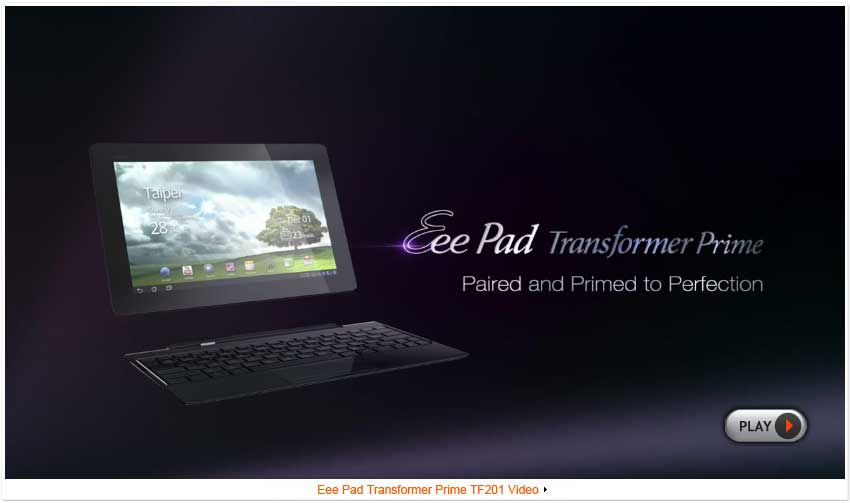
Stunning and beautiful. Paired and Primed to Perfection
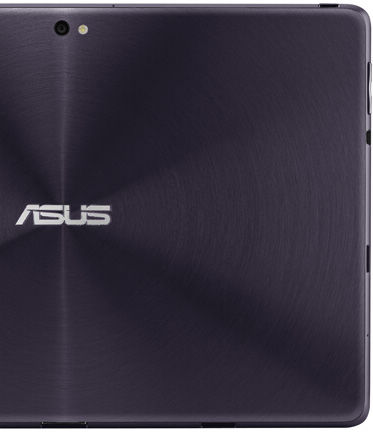
The metallic spun finish on the ultra-slim and light Transformer Prime sets a new benchmark in the art of tablet design. Only 8.3mm thin and 586g light, the Transformer Prime re-defines the rule of the mobile life, making it super easy to carry and transport.

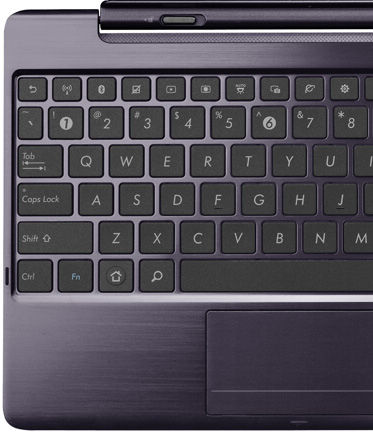
Transform to notebook mode with a full QWERTY chiclet keyboard dock and up to 18 hours* of battery life
Admit it! You miss the touch and feel of a real QWERTY keyboard. The Transformer Prime offers you a choice to enjoy both notebook mode and tablet mode with the optional mobile dock.
The mobile dock offers a full QWERTY keyboard with touchpad and USB port, while also extending battery life to an incredible 18 hours for all day computing on the go.
*Battery life is measured under power saving mode, playing 720p video playback, Brightness:60nits, default volume with headphones
Supreme sound offering by SonicMaster technology
Tuned by the ASUS Golden ears team, audio on the Transformer Prime is delivered with the most precise processing protocols and codecs, superior speaker construction and large resonance chambers for unforgettable audio enjoyment.

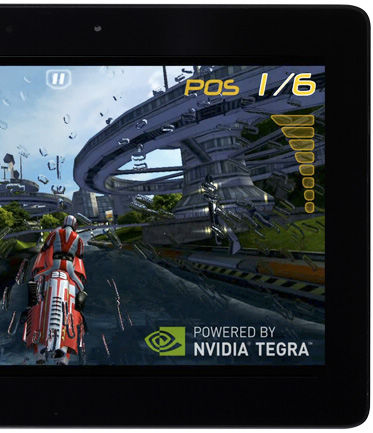
Playing games beyond the tablet boundary. Maximum 3D performance.
Advanced water effects, realistic textures and material display, motion blur effects, camera splash effects and all kinds of new 3D effects have been added to the Transformer Prime. It offers superb 3D graphics performance previously unseen on a tablet.

Android™ Market and social media access
Over 500,000 apps are available on the Android™ Market to compliment your tablet experience. You also have access to various social networks such as Facebook and Twitter.
ASUS exclusive technology – Power Saving Mode
When traveling for an extended amount of time, users can turn on "Power Saving Mode" to extend the battery life even more.
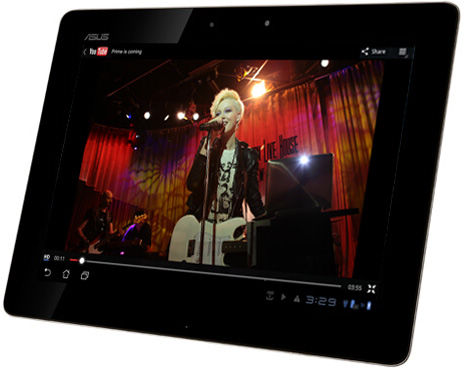
Super IPS+ panel provides vivid images on the go
An IPS panel made from durable and scratch-resistant Corning® Gorilla® glass is viewable at angles up to 178°, producing a crisper and more accurate color range.

SuperNote - super great app for more than note taking
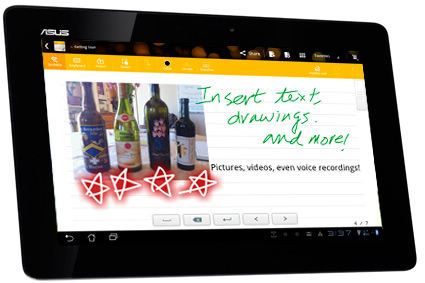
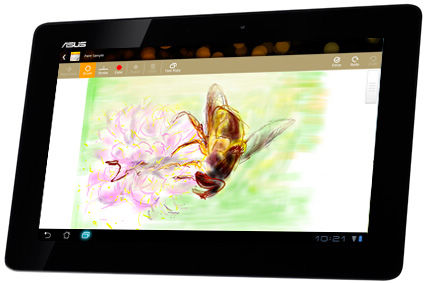
SuperNote is a versatile note taking app that allows users to take notes and information through a variety of options, including the keyboard, finger input, photo and video capture or audio notes.

Magazines, newspapers and books: rich content for everyday use
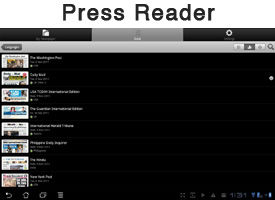
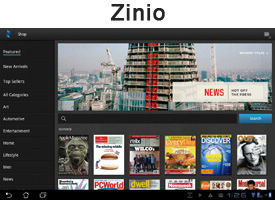
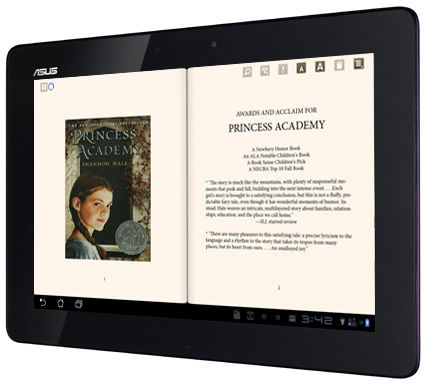
In addition to the music and videos provided in MyCloud, the Transformer Prime also offers accessibility to purchase newspapers from Press Reader, magazines from Zinio and books from Amazon Kindle. With the Transformer Prime, drop the heavy books and papers from your life.

Polaris® Office® 3.0, a professional mobile office Solution
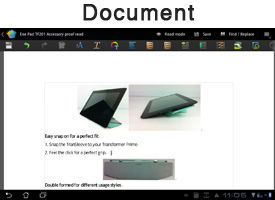
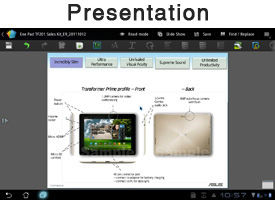
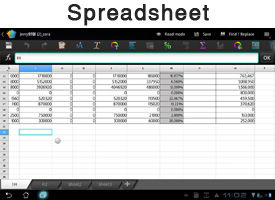
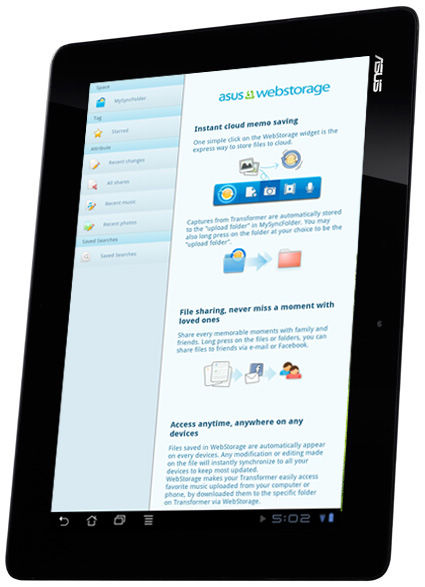
Preloaded on the Transformer Prime is Polaris® Office® 3.0, a professional mobile office Solution which enables users to edit various types of office documents including documents (.doc), spreadsheets (.xls) and presentation (.ppt) files, making the Transformer Prime very attractive for professional use. In addition, the ultra-convenient ASUS webstorage with 8G life time FREE space for easy sharing & expandability.
Android™ 4.0 Ice Cream Sandwich with ASUS Waveshare UI

Android™ 4.0 Ice Cream Sandwich is a revolutionary operating system specially designed and optimized for tablets, and enables users a full web experience for on-the-go web browsing, communicating and casual computing. Supporting Adobe® Flash® and the ever growing Android™ Market, entertainment is a finger swipe away.
The convenient ASUS Launcher also allows users to easily launch software, manage content and access online services and connect devices with a few simple taps.
MyCloud :
MyCloud is a total cloud solution, providing access to digital content such as music, videos, and files from the cloud. Users can even use MyCloud to remotely access and control PC or Mac systems, which further extends the versatility of the Eee Pad Transformer Prime.

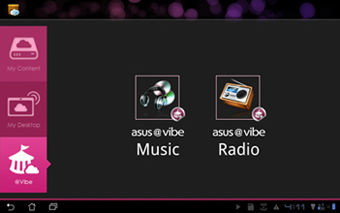
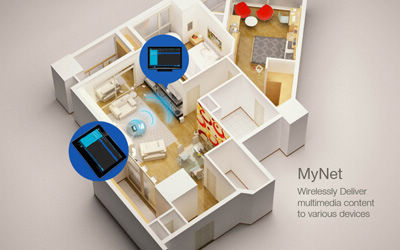
MyNet
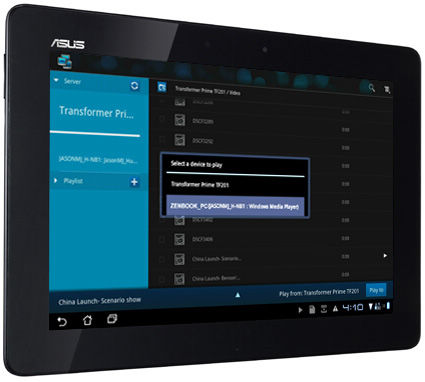
MyNet easily streams digital media wirelessly within home network devices so HD videos or music can be played on devices such as an HDTV or desktop PCs for an even better experience from the Transformer Prime.
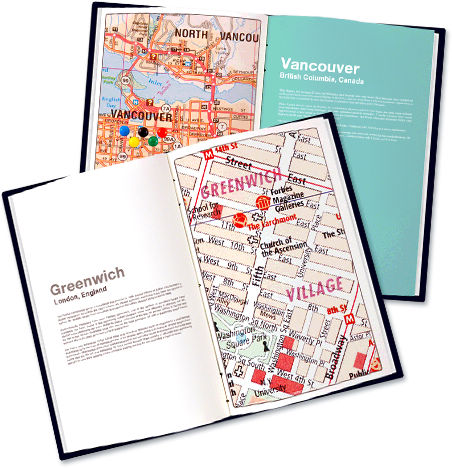
MyLibrary:
MyLibrary consolidates downloaded books, magazines and newspapers in to one easy step.
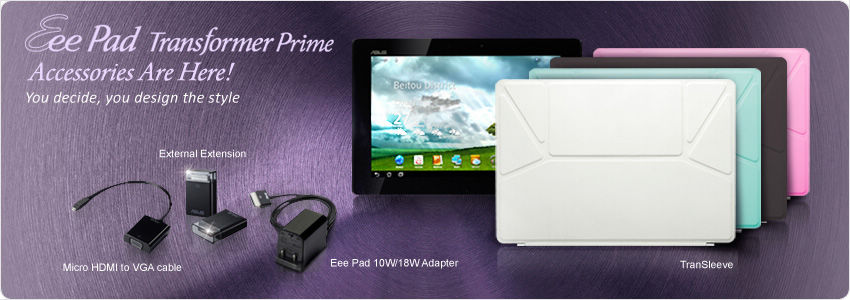
Eee Pad Transformer Prime Accessories
| |
|
|
|
|
|
|
|
Padfone
17/12/2012 01:51
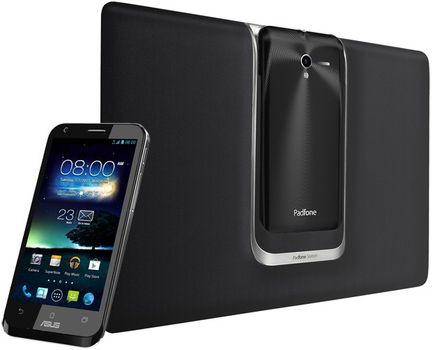
Au salon MWC 2012 en février, Asus avait fait sensation avec son Padfone, smartphone s'intégrant dans une tablette. Le concept revient avec le Padfone 2 dans une version affinée
En quête de nouvelles idées anticipant les besoins de demain en termes de produits nomades, le taiwanais Asus avait dévoilé au salon MWC 2012 de Barcelone son Padfone, un smartphone Android pouvant servir de " coeur communicant " une fois glissé au dos d'une tablette qui peut elle-même accueillir un dock/clavier, l'ensemble formant un quasi-PC.
Le Padfone, initialement prévu pour le mois d'avril 2012, a finalement mis beaucoup plus de temps pour être commercialisé et voici déjà venir son successeur, l'Asus Padfone 2, qui reprend la même idée en y apportant un certain nombre d'améliorations.
Le Padfone 2 est donc à la base un smartphone Android doté d'un affichage 4,7" avec dalle IPS et résolution 720p ( 1280 x 720 pixels ), accompagné d'un processeur 13 megapixels et embarquant un processeur quadcore SnapDragon S4 1,5 GHz ( APQ8064 ) de Qualcomm avec 2 Go de RAM ( contre un processeur dual core, également de la famille SnapDragon S4, pour le premier Padfone ).
<a href='http://http://188.165.12.99/ox/delivery/ck.php?n=a2377e0a&amp;cb=91484157' target='_blank'><img src='http://http://188.165.12.99/ox/delivery/avw.php?zoneid=224&amp;cb=91484157&amp;n=a2377e0a' border='0' alt='' /></a>
Et comme son prédécesseur, il pourra être glissé dans une tablette 10,1" 1280 x 800 pixels, la Padfone 2 Station, dont l'épaisseur et le poids ( 650 g ) ont été réduits par rapport à la précédente version. Le mécanisme d'insertion du smartphone a également été revu, abandonnant le dispositif avec capot pour un système à glissières sans doute moins fragile. En revanche, la partie clavier du Padfone initial a été abandonnée.
D'une batterie 2140 mAh embarquée dans le Padfone 2 et assurant 16 heures d'autonomie en conversation 3G et 13 heures en usage WiFi, le couple Padfone 2 / Padfone 2 Station atteint les 36 heures d'autonomie en conversation 3G grâce à la batterie 5000 mAh intégrée dans la tablette.
Le smartphone embarque en outre un module NFC et est compatible 4G LTE, tandis que le stockage ira de 32 à 64 Go en interne, auquel on pourra ajouter 50 Go en cloud via le service Asus WebStorage. Les données entre le smartphone et la tablette sont synchronisées lorsque les deux appareils sont connectés.
La commercialisation du Padfone 2 et de la Padfone 2 Station est prévue d'ici la fin du mois de décembre 2012 sur plusieurs marchés en Europe ( mais pas en France, qui devra sans doute attendre un lancement début 2013 ). Le couple smartphone / tablette en version 32 Go sera proposé pour 799 € tandis que la version 64 Go coûtera 899 €.
| |
|
|
|
|
|
|
|
Transformer TF101
17/12/2012 01:36

La Asus EeePAD Transformer TF101 c'est le résultat de l'hybridation de la tablette et du netbook avec un vrai potentiel pour devenir un nouveau format.

Avec la EeePAD Transformer TF101 Asus joue sur 2 tableaux que tout le monde s'accorde pourtant à soigneusement distinguer : Le monde des netbooks d'abord avec des engins compacts disposant d'une interface classique avec clavier et pavé tactile. Le monde des tablettes qui émerge cette année. La Transformer c'est le résultat de l'hybridation de ces 2 univers avec une maîtrise étonnante et un vrai potentiel pour devenir un nouveau format.
L'idée n'est pas nouvelle et le jeu est donc assez dangereux pour Asus. On en a déjà vu des mix inter-machines qui promettaient le meilleur des deux mondes et malheureusement la plupart de ces hybrides n'ont pas eu grand effet sur les résultats financiers des marques qui les promulguaient "solution d'avenir". Si ces engins n'ont pas rencontré leur public ce n'est pas par peur de l’innovation mais bien parce que derrière un joli discours marketing se cache souvent une efficacité et une ergonomie médiocres. Le pari d'Asus est de proposer non pas une machine "universelle" mais de présenter la TF101 comme une tablette identique au reste de l'offre du marché sur laquelle on pourrait greffer un clavier. La Transformer c'est avant tout un modèle très standard, une tablette Android 3.0 comme les autres, mais extensible à un mode plus productif par l'intermédiaire d'un simple dock.
Caractéristiques constructeur

Asus EeePAD Transformer TF101
-
Matériaux : ABS, vitre Corning Gorilla Glass
-
Dimensions : 271 x 177 mm. Épaisseur 12.98 mm.
-
Processeur : Nvidia Tegra 2 double coeur 1GHz
-
Mémoire vive : 1 Go
-
Stockage : 16 ou 32 Go de SSD
-
Affichage : 10.1” en 1280 x 800 à rétro éclairage LED Brillant
-
Type de dalle : IPS
-
Tactile : Capacitif multipoint 10 contacts
-
Réseaux: WiFi 802.11b/g/n, Bluetooth, GPS, DLNA
-
Connectique tablette : 1 sortie casque et entrée micro combinées, 1 port Mini HDMI 1.3a, 1 lecteur de carte MicroSDHC
-
Connectique Dock-clavier : 2 ports USB 2.0, 1 lecteur de carte SDHC
-
Audio : Audio SRS Premium, 2 haut-parleurs stéréo, microphone
-
Webcam Frontale : 1.2 megapixel
-
Webcam Façade : 5 megapixels
-
Batterie tablette : Lithium Polymer 9.5 heures autonomie Wifi annoncées
-
Batterie dock-clavier : Lithium Polymer 6.5 heures autonomie Wifi annoncées
-
Poids tablette : 688 grammes
-
Poids dock-clavier : 635 grammes
-
Système d’exploitation : Android 3.0 Honeycomb
-
Prix : 399€ 16Go / 499€ 16Go + Dock / 499€ 32Go / 599€ 32Go + Dock
-
Disponibilité : 6 Juin 2011
-
Nombreux accessoires compatibles annoncés
-
Test effectué à partir d'une version commerciale anglaise francisée et une pré-série française de la tablette.

Public visé
L'EeePAD Transformer si ce n'est pas déjà un mythe, c'est déjà l'objet qui cristallise beaucoup d'attentes dans le petit public qui s’intéresse à ce marché des tablettes tactiles Android. Un écran tactile c'est bien, c'est amusant et c'est tendance mais cela ampute l'utilisateur d'une grosse partie de son potentiel de créativité et de production. Asus propose donc un engin mixte, un engin qui ressemble autant à une tablette qu'à un netbook et à vrai dire la principale inconnue de la machine ne vient pas vraiment de son équipement ni de sa finition mais plutôt de la pertinence du système d'exploitation embarqué.
Potentiellement, Asus a là une machine qui pourrait prendre la place de 3 autres : La tablette tactile, actuellement mise à l'honneur depuis l’avènement de l'iPad. Le netbook, ce précieux compagnon de travail et de loisir au quotidien. Et enfin le jukebox numérique qui orne de plus en plus de salons.
| |
|
|
|
|